HolikStudios Media Group - https://holikstudios.com
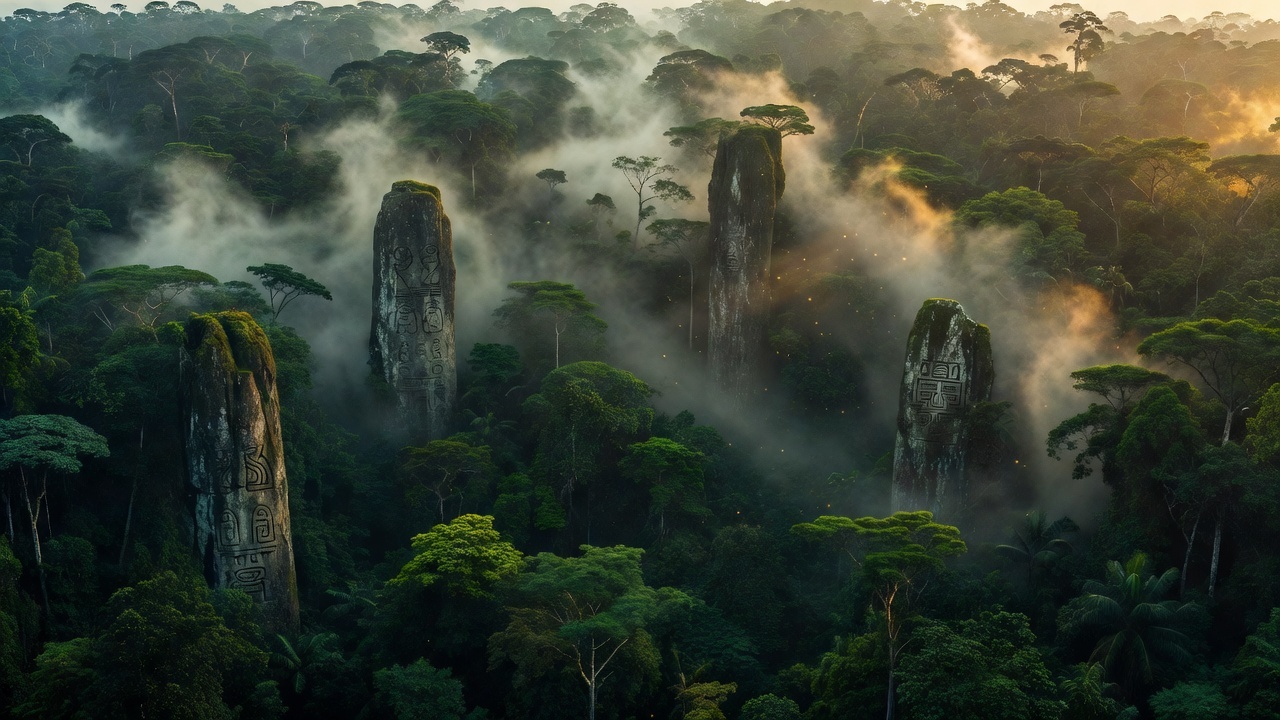
For most of the last century the official story of the Amazon rainforest was remarkably simple. It was an empty wilderness, home to scattered hunter-gatherer tribes who left nothing behind but arrows and ash. Civilization, according to the textbooks, had a single birthplace somewhere in the Middle East, and from there it spread outward like ripples in a pond. The Americas, they said, were a latecomer. The Amazon was the last place on Earth you would expect to find a lost civilization.
Then the trees started giving up their secrets, and the careful arrangement of facts began to wobble.
The World That Was Supposed to Be Impossible
Twenty thousand years ago the planet was a different place. The great ice sheets had not yet retreated, sea levels were far lower, and land bridges connected continents that are now separated by open water. In this world, Graham Hancock argues, an advanced civilization flourished. Not a few scattered camps, but a sophisticated culture of engineers, astronomers and builders. Then, roughly 12,000 years ago, something enormous happened. A cosmic impact, a global catastrophe, a flood of mythic proportions. Whatever it was, it erased almost every trace of that civilization, leaving only the stories that later peoples passed down as legend.
Hancock laid this theory out across decades of books, and then he brought it to television. In the Netflix series Ancient Apocalypse he travels the world hunting for the wreckage of that lost world. Season one takes him to the oldest monumental site ever found. Season two turns to the Americas and the Amazon. And the story he tells connects them all with a single thread.
Gobekli Tepe: The Hill That Broke the Timeline
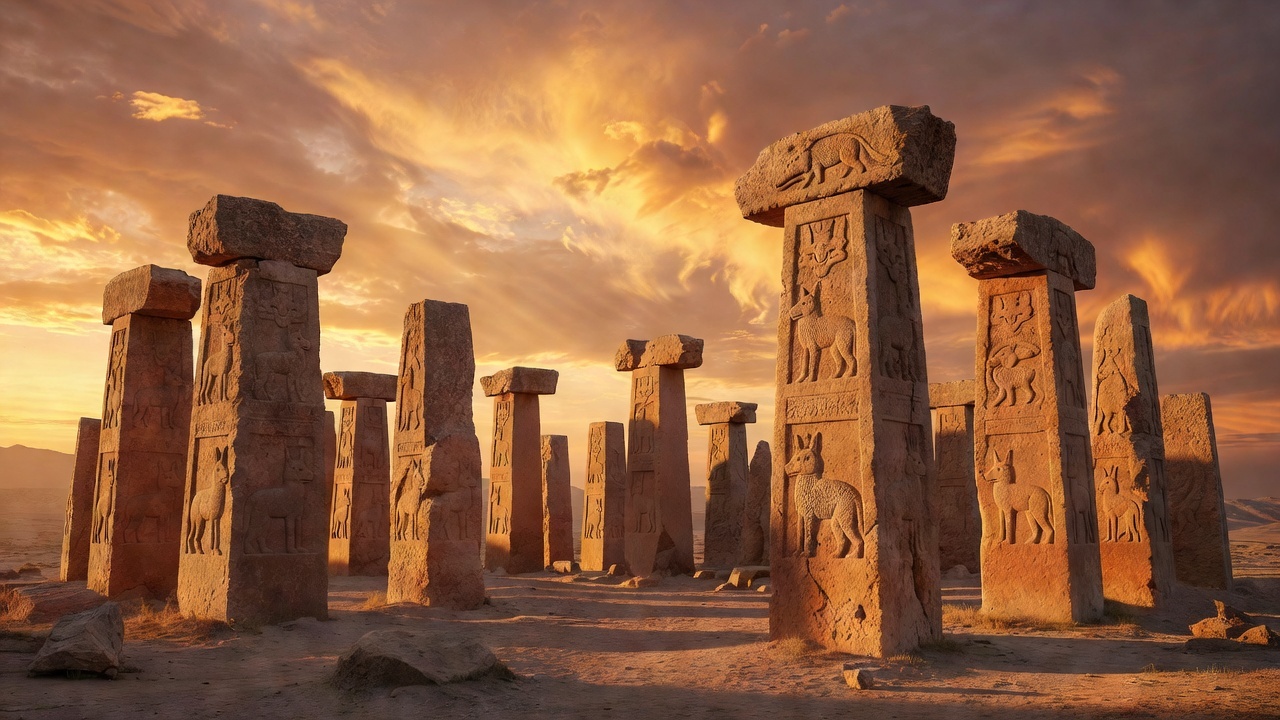
Everything begins on a hill in southeastern Turkey called Göbekli Tepe. In archaeological terms it is obscene. It should not exist. It was built around 9,500 BCE, which means it predates pottery, predates the wheel, predates farming and writing. The people who raised its massive stone circles had supposedly not yet invented agriculture. They were, by every official measure, simple hunter-gatherers wandering the land for food.
And yet they carved enormous T-shaped pillars out of solid limestone, some weighing tens of tonnes, dragged them to the hilltop, and arranged them in elaborate circles. The pillars are covered with low relief carvings: foxes, snakes, birds, boars, scorpions, strange abstract symbols. These were not casual doodles. Many researchers now believe the animals on the pillars encode astronomical knowledge, and that some of the symbols may mark specific dates, perhaps even the date of an ancient sky-borne catastrophe.
We have already dug deep into this mystery in our piece on Göbekli Tepe and the secret to early human civilization. The question that keeps the site so unsettling is blunt: how did people who supposedly had no settled life, no surplus food and no division of labor coordinate the building of something this monumental? The standard answer, that bands of hunter-gatherers just happened to cooperate for centuries, strains credibility. Something was different about these people.
The Uncomfortable Question There Is No Easy Answer For
Orthodox archaeology offers a patient, reasonable explanation. Gobekli Tepe, they say, was built by the people who would go on to invent farming. The great effort of its construction itself forced them to settle, to grow grain to feed the builders, and so agriculture was born. It is a neat reversal: the monument came first, and then the civilization it made possible.
Hancock and his followers push further. What if the builders of Gobekli Tepe were not the source of this knowledge, but the inheritors of it? What if an older, wiped-out civilization taught its survivors to build, and those survivors taught the hunter-gatherers? In that reading, Gobekli Tepe is not the cradle of civilization. It is a memorial, built by the descendants of people who remembered a world that no longer existed, marking the knowledge they were losing. The animals carved into the stone, in this reading, are not decoration. They are a warning written in a language we are only starting to decode.
A Thread That Leaps the Atlantic
Here is where the story takes its strangest turn. If an advanced culture was destroyed by a cataclysm around 12,000 years ago, its survivors did not simply vanish. They would have scattered, sailing and walking to every corner of the habitable world, carrying their knowledge with them. And if they did, the Americas should hold traces of the same story as the Middle East.
For a long time, the evidence for that was dismissed out of hand. The Americas, the argument went, were settled late and sparsely. They could not possibly have built monumental societies anywhere near as early as the Old World. It was an assumption that was never really tested, because nobody could see the ground. The Amazon rainforest had become a green wall, one canopy deep, hiding everything beneath it for centuries.
When the Machines Learned to See Through the Jungle
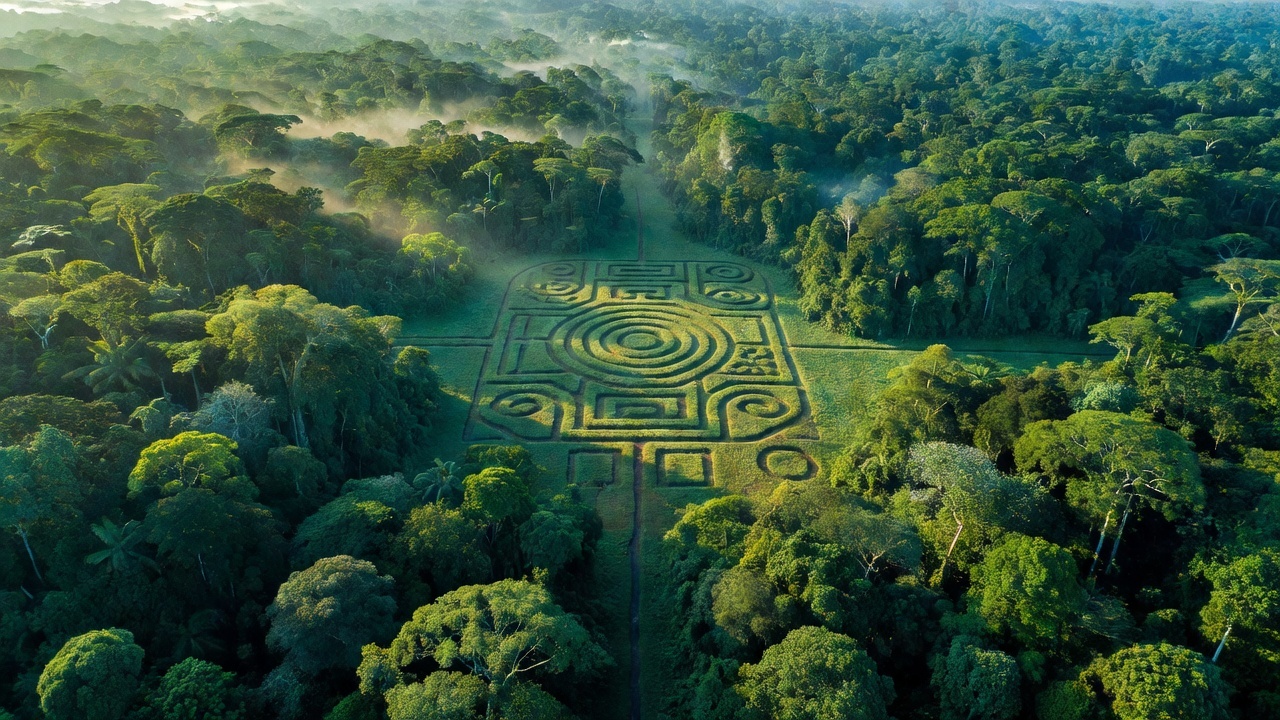
The breakthrough came not from shovels but from lasers. Airborne LIDAR, short for Light Detection and Ranging, sends millions of light pulses down toward the ground. The pulses scatter off the leaves, and a scanner measures how long each one takes to come back. Strip out the canopy mathematically, and what remains is a stark, ghostly map of the earth underneath. For the first time, archaeologists could see the floor of the Amazon without cutting down a single tree.
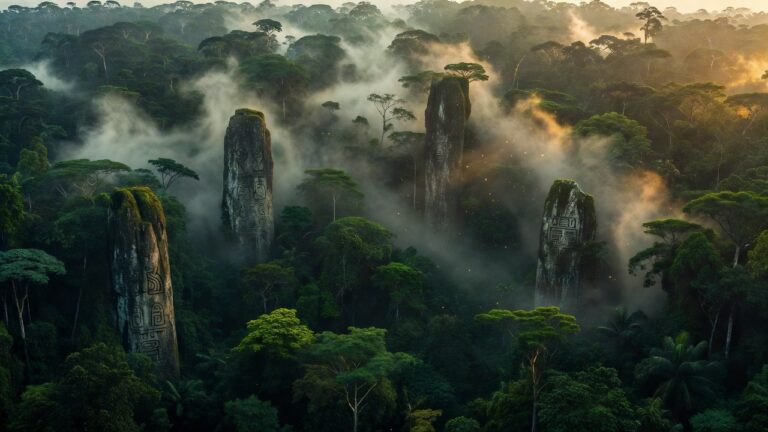
What those scans revealed was almost impossible to square with the old story. Beneath the canopy lie not a few scattered villages but thousands of earthworks: massive geometric geoglyphs, straight causeways running for kilometers, defensive ditches, monumental mounds. Researchers have identified what is sometimes called the Aquiry civilization, a sprawling network of more than 20,000 earthworks that may have supported a population of up to three million people. Three million. That is not a handful of tribes. That is a society with engineers, planners, logistics and ceremony.
This is the point where the official story starts to bend. A sophisticated, widespread civilization existed in the heart of the Amazon, in an environment that supposedly made civilization impossible. And its collapse appears to have come at roughly the same time as the fall of the Maya, another civilization that, by the old timeline, should not have been nearly as advanced as it was.
The quiet work of these machines is exactly what we explored in our article on how AI is uncovering ancient mysteries from lost cities to forgotten texts. The lasers and the algorithms are finding, in a few years, what human eyes walked past for centuries. We spent generations looking at the surface. The machines looked through it.
Coastal Peru: Proof the Americans Build Early
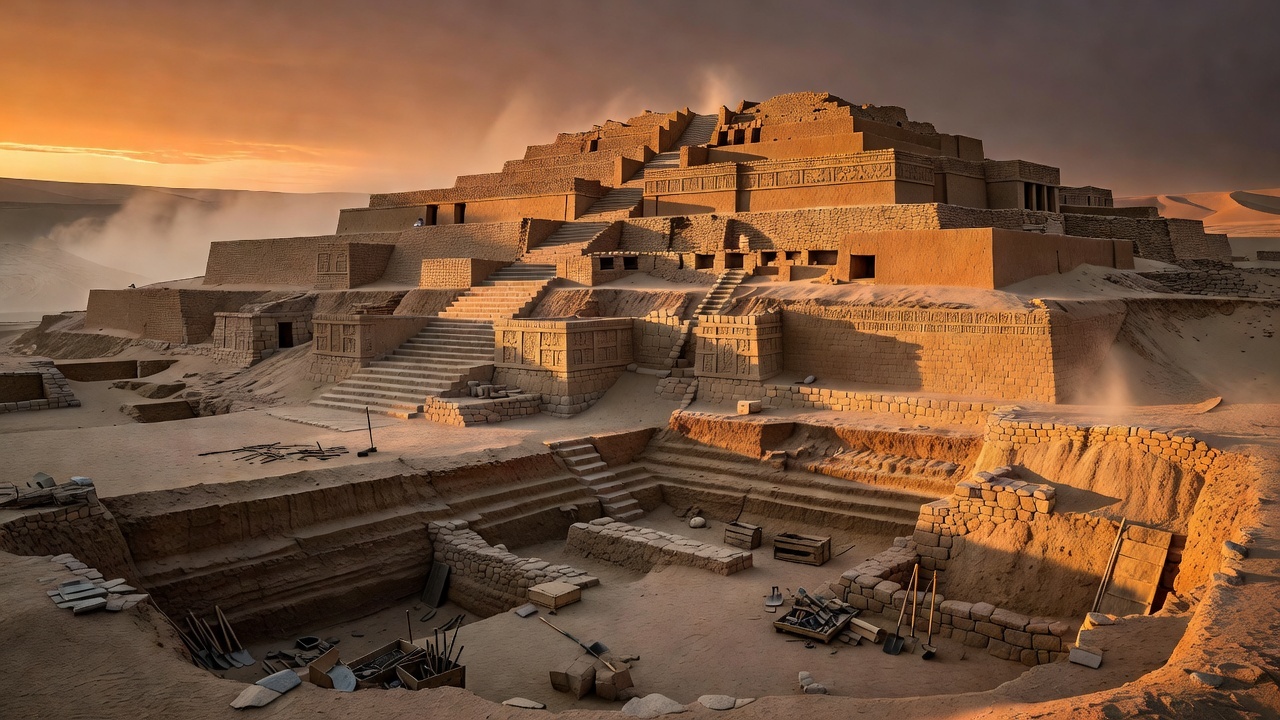
The Amazon is not the only place the Americas have refused to behave. Along the coast of Peru, archaeologists have uncovered a 4,000-year-old temple and theater, a complex ceremonial center with plastered walls, stairways and a theatrical space, built thousands of years before the Inca empire. A theater, four millennia deep in time, in a place where grand public architecture supposedly arrived late.
Layer the Peruvian temple on top of the Amazonian earthworks, and a pattern emerges that has nothing to do with a single site. It is a civilization that built for ceremony, for astronomy, for public life, across a huge swath of South America, at depths of time that the old textbooks never allowed. The standard narrative wants civilization to be a single river that flowed out of the Middle East. The evidence suggests it was more like an ocean, with many currents rising at once.
Burying Things and Finding Them Again
There is a persistent pattern in the history of discovery that is worth sitting with for a moment. Time after time, something is declared settled, and then something old surfaces to unsettle it. A 200-year-old message in a bottle discovered recently in France is a small, charming version of it: a note buried, forgotten, presumed lost, then found and read again. The Amazon is simply the largest, most stubborn version of that same bottle. Whatever is written on its floor is still being read, and we have only just cracked the seal.
Could There Be a Single Lost World Behind All of It?
Here is where the speculation begins in earnest, and where Hancock’s theory gains its strange power. Consider the pieces on the table. A monumental hilltop sanctuary in Turkey that predates farming, whose pillars may encode a sky catastrophe. A vast network of Amazonian earthworks supporting millions of people, collapsed around the same era as the Maya. Coastal temples in Peru built four millennia into the past. And a global tradition of flood myths, falling sky gods and lost golden ages, shared by cultures who supposedly never met.
What if all of these are not separate curiosities, but echoes of a single event and a single people? What if a relatively advanced civilization was cut down by cosmic catastrophe around 12,000 years ago, and its survivors, carrying fragments of its knowledge, seeded the legend of a lost world in every corner of the planet? In that reading, the builders of Gobekli Tepe, the mound-builders of the Americas and the engineers of the Amazon are cousins, all telling fragments of the same interrupted story. The carved pillars of Turkey and the geometric geoglyphs of the jungle may be the two surviving pages of the same erased book.
Mainstream archaeology calls this speculation unsupported, and it is fair to say the chain is held together with inference more than proof. But consider how many times the official story has had to be revised in the last two decades. Every LIDAR flight, every new dig, keeps pushing the origins of American civilization further back. Each revision moves the official timeline a little closer to the version the fringe writers described first. That is the uncomfortable part. The people dismissed as cranks keep writing chapters that the archaeologists eventually catch up to.
Why This Should Matter to Every Demon Hunter
This site is built on the assumption that the world is stranger than we are told, that hidden forces and buried histories shape the present. The lost civilization of the Amazon sits squarely in that territory. It is not a monster story or a possession tale, but it belongs to the same family: the world is not what it appears, and beneath the surface of official reality, another one is hiding.
There is also an even darker thread worth following. The people of the Amazon did not simply fade away. Evidence points to a collapse, and some researchers connect it to the same kind of environmental and social pressures that stalk our own world. If a civilization of millions built its cities in the jungle and then vanished under the canopy, there is a warning buried in its silence. The same way the forest has taken those who walked into its depths unprepared, it swallowed an entire civilization that once thought itself secure.
What is buried in the rainforest is more than ruins. It is the memory of a people who built impossibly, who were erased, and whose records the jungle has held for millennia. The machines are finally reading them. And every new line they read asks the same question that haunts Gobekli Tepe, that haunts the Peruvian temple, that haunts every buried message the world keeps finding: what else have we been told to look away from?
Keep Following the Thread
We may never hold the whole answer, but the threads keep leading somewhere, and that is enough to follow. Start at the megaliths of Turkey, where the timeline first broke. Travel to the ancient temple of Peru, where the Americas refused to behave. Let the machines keep digging through the canopy for what the lasers are pulling out of the green dark. And remember the bottle that was buried, forgotten and found again: history is patient, and so is the ground that keeps it.
We have only begun to read what the rainforest has been holding. The deeper the machines look, the harder it becomes to unsee what has been hiding in plain sight all along. Somewhere beneath that canopy, a civilization is still waiting to be acknowledged, and every laser pulse brings it one step closer to the surface.
About the Author





Great piece congrats on pulling all these threads together without losing the plot, that’s harder than it looks. The LIDAR section is what got me; we spent centuries staring at a green wall and assuming there was nothing behind it just because our eyes weren’t built for the job.
I work in digital content, and there’s a strange parallel here. A friend of mine does marketing with Holik Studios and she likes to say the data doesn’t create the opportunity, it just stops you from lying to yourself about it. Amazon LIDAR feels like the archaeological version of exactly that the ruins were never hiding, we just refused to look properly.
One thing I keep circling back to: if those earthworks really supported millions and collapsed around the same window as the Maya, do you read that as coincidence, climate, or something more deliberate? Because that’s the part I can’t get past.
Stephen here. Ancient civ dropout, current doomer. Holik Studios friend nailed it data doesn’t create opportunity, just stops you lying to yourself. But Khloe’s framing is backwards. LIDAR doesn’t prove millions lived there; it proves we can see dirt rectangles now. Same collapse window as Maya? That’s climate + soil exhaustion + overcomplexity, not some deliberate hidden hand. Radical view: no thread, no lost master race, just humans repeatedly building past carrying capacity and getting eaten by jungle. The ruins weren’t hiding. Our hubris was.