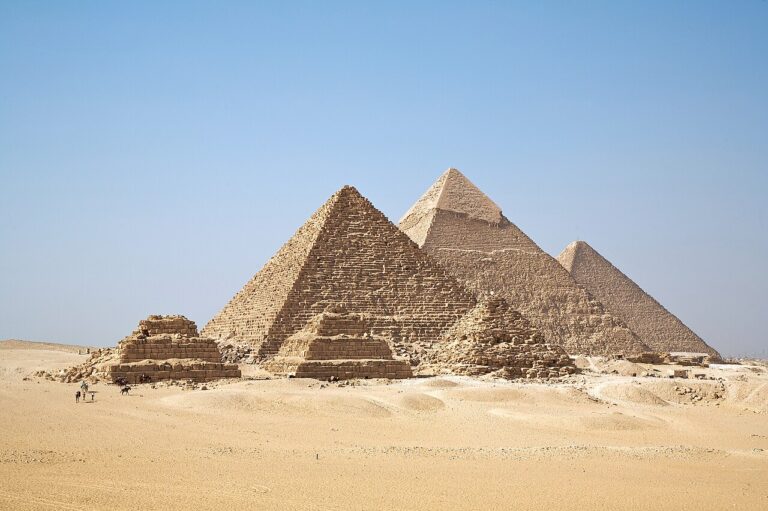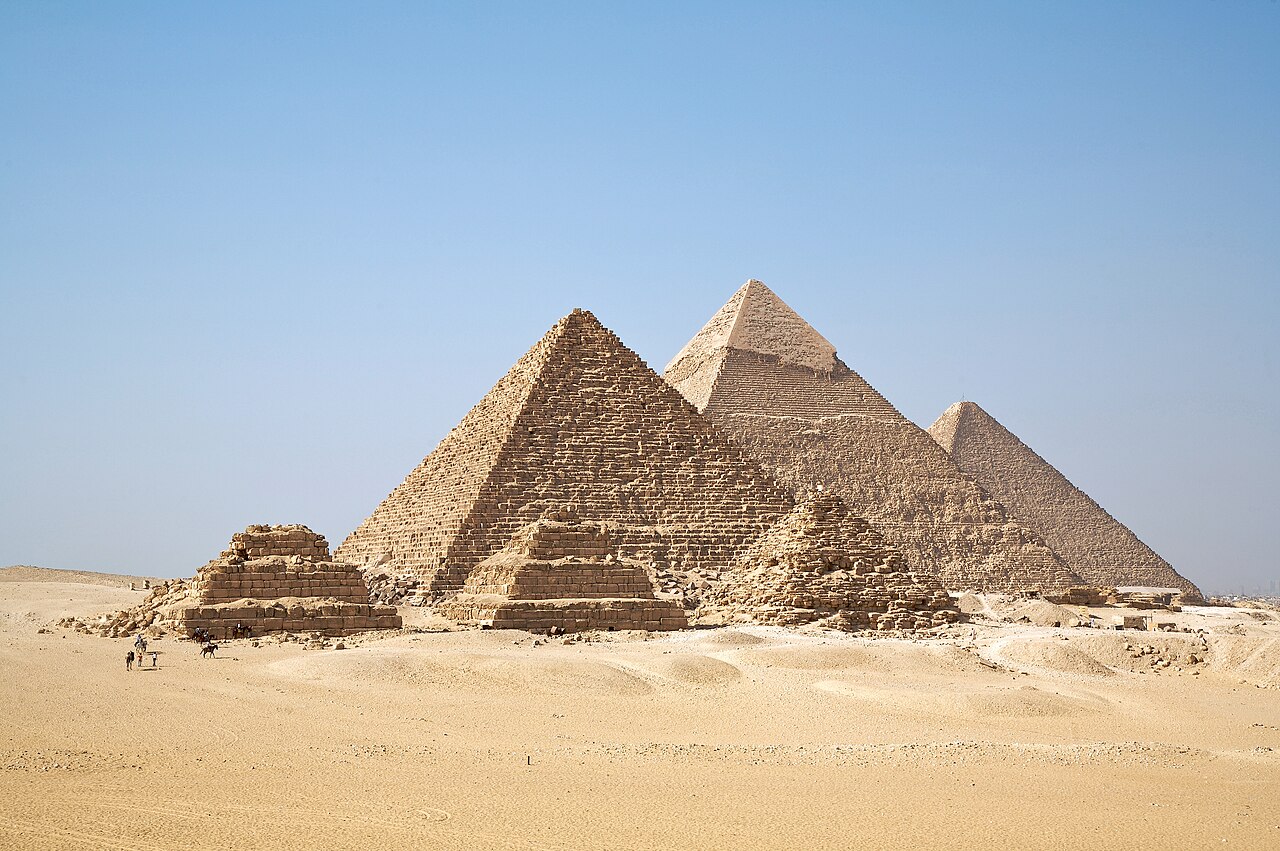
The Great Pyramids of Giza - symbols of ancient mystery now being explored with cutting-edge artificial intelligence
In the hushed corridors of the world’s great museums and the remote corners of forgotten archaeological sites, a revolution is quietly unfolding. Artificial intelligence—once the realm of science fiction—is now revealing secrets that have remained hidden for millennia. From deciphering charred scrolls buried by volcanic ash to mapping entire civilizations beneath impenetrable jungle canopies, AI is transforming archaeology from a discipline of patient excavation into one of digital revelation. As someone who has spent years studying the intersection of folklore and archaeological evidence, I find myself witnessing the dawn of a new era—one where algorithms are becoming our most powerful tools for understanding the past.
Section I: The Resurrection of Lost Words
For centuries, the inability to read ancient texts has been one of archaeology’s most maddening limitations. Countless scrolls, inscriptions, and manuscripts have remained silent witnesses to history, their contents locked away by time, damage, or the extinction of the languages in which they were written. Today, machine learning algorithms are achieving what human scholars alone could not.
The Dead Sea Scrolls and the Power of Pattern Recognition
The Dead Sea Scrolls, discovered in the mid-20th century, represent one of the most significant archaeological finds in human history. Yet even after decades of study, many fragments remained unreadable—damaged by time, torn into pieces the size of postage stamps, or faded beyond human recognition. Enter artificial intelligence.
Researchers at the University of Groningen and the University of Haifa have developed neural networks capable of analyzing these fragments with unprecedented precision. By training algorithms on the handwriting styles of known scribes, AI systems can now identify which fragments belong together, even when the pieces themselves seem unrelated to the human eye. More remarkably, these systems can predict missing text with startling accuracy, reconstructing passages that have been lost for two thousand years.
Key achievements in AI text decipherment include:
- Fragment reconstruction: Algorithms identifying matching edges of damaged scrolls with 90%+ accuracy
- Ink detection: AI spotting invisible ink traces on damaged papyrus using multispectral imaging
- Handwriting analysis: Machine learning identifying individual scribes across multiple fragments
- Language prediction: Neural networks reconstructing missing words based on context and linguistic patterns
DeepMind’s Ithaca: Reading the Unreadable Inscriptions
Perhaps no single tool has revolutionized epigraphy—the study of ancient inscriptions—more profoundly than DeepMind’s Ithaca. Named after the mythical home of Odysseus, this neural network represents a quantum leap in our ability to read damaged or incomplete Greek inscriptions from across the ancient world.
“Ithaca doesn’t just fill in gaps; it changes how we approach epigraphic evidence entirely. We’re no longer limited to what we can see with our eyes or deduce through traditional methods.”
— Dr. Thea Sommerschield, University of Oxford and Ithaca Project Lead
What makes Ithaca remarkable is its ability to restore damaged texts, attribute them to specific time periods and locations, and even identify the authorial hand—all with remarkable accuracy. In testing, Ithaca achieved 62% accuracy in restoring damaged inscriptions, compared to 25% for human historians working alone. When humans and AI collaborate, accuracy jumps to 72%.
The system was trained on over 78,000 ancient Greek inscriptions, learning patterns that span from the archaic period (8th century BCE) to the early Byzantine era (5th century CE). This vast training dataset allows Ithaca to recognize stylistic changes across centuries and regions, making it possible to attribute fragmentary inscriptions to their original contexts with unprecedented confidence.
Consider the implications: thousands of inscriptions currently sitting in museum storerooms, unreadable due to damage, may now yield their secrets. The Ancient History Encyclopedia estimates that only 5% of surviving ancient Greek inscriptions have been properly published and studied. Ithaca offers the promise of unlocking the remaining 95%.
The Vesuvius Challenge: Reading Carbonized Scrolls
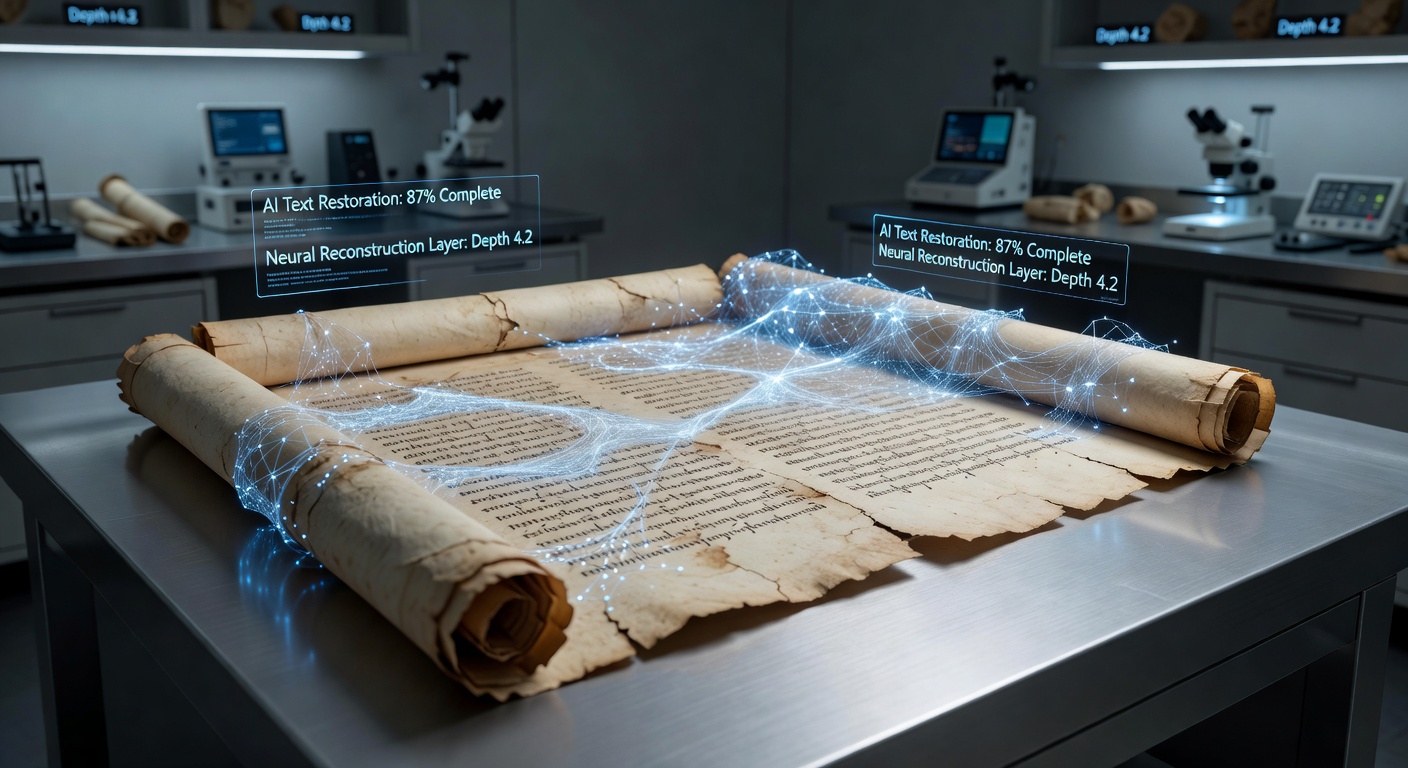
Among the most tantalizing mysteries in classical archaeology are the Herculaneum papyri—approximately 1,800 carbonized scrolls recovered from the Villa of the Papyri in Herculaneum, buried by the same eruption of Mount Vesuvius that destroyed Pompeii in 79 CE. These scrolls, turned to carbon by volcanic heat, have resisted every attempt to unroll them physically. Previous efforts have destroyed more scrolls than they’ve revealed.
The 2023-2024 Vesuvius Challenge changed everything. Using a combination of high-resolution CT scanning and machine learning algorithms developed by former GitHub CEO Nat Friedman’s team and researchers at the University of Kentucky, scholars successfully read the first passages from these scrolls in nearly two thousand years.
The breakthrough came from an unexpected source: a group of young researchers including Luke Farritor, Youssef Nader, and Julian Schilliger, who used AI to detect subtle patterns in CT scan data that revealed ink traces invisible to previous methods. The algorithm they developed, nicknamed “Luminous,” can identify the raised patterns left by ancient ink on papyrus—even when the papyrus itself has been carbonized into a solid black mass.
The first text revealed? A previously unknown philosophical work discussing pleasure—possibly written by Philodemus, a philosopher who taught the father-in-law of Julius Caesar. The implications are staggering: an entire library from antiquity, preserved by volcanic catastrophe, may finally be readable thanks to artificial intelligence.
Section II: From the Sky to the Jungle: Satellite Archaeology
While AI is revolutionizing our ability to read ancient texts, it is equally transformative in our capacity to find lost cities themselves. The dense jungles of Central America, the vast deserts of the Middle East, and the rugged terrain of Southeast Asia have long concealed the remains of ancient civilizations. What LiDAR (Light Detection and Ranging) and AI-driven satellite imagery are revealing is nothing short of extraordinary.
The Maya Megalopolis: A Revolution in Jungle Archaeology
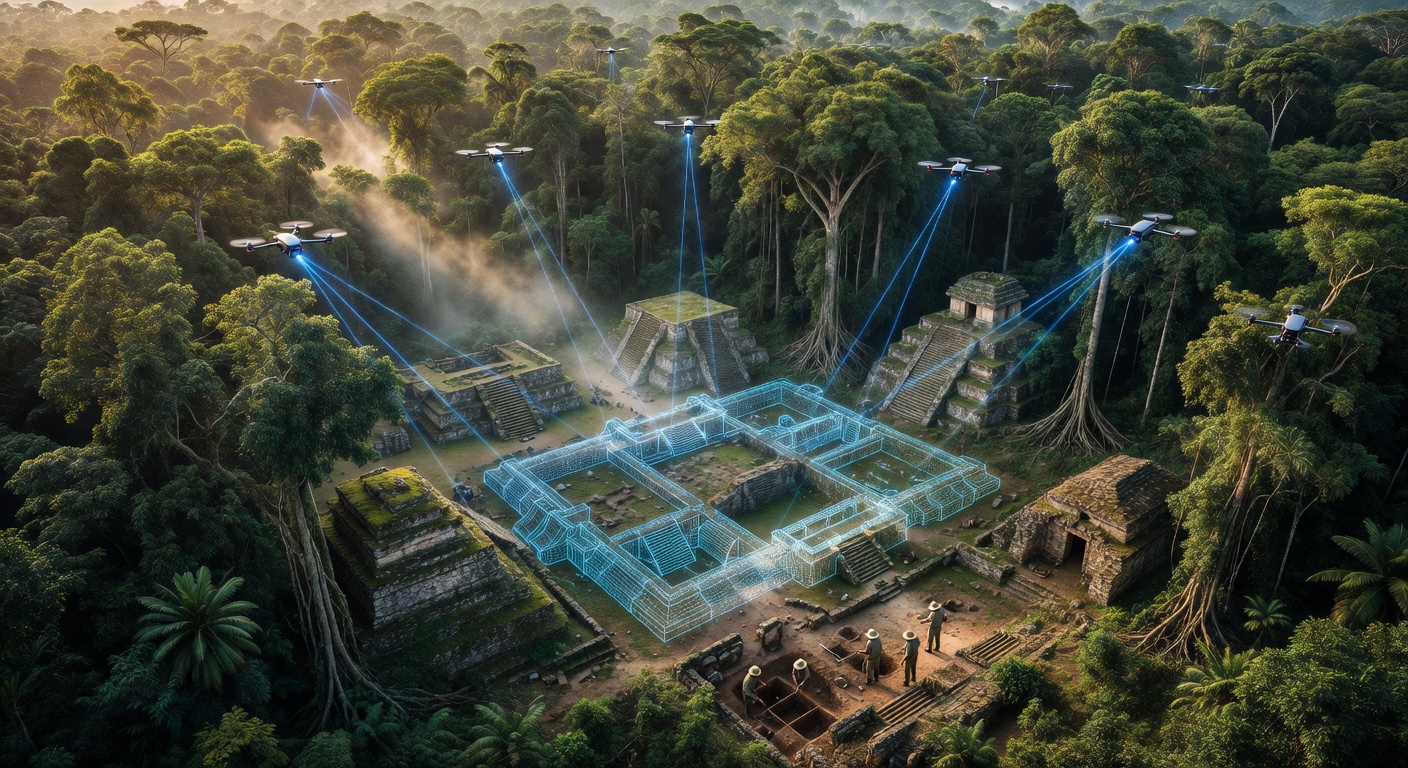
In 2018, a consortium of researchers led by the PACUNAM LiDAR Initiative unveiled findings that fundamentally reshaped our understanding of Classic Maya civilization. Using aircraft-mounted LiDAR sensors to penetrate the dense canopy of Guatemala’s Maya Biosphere Reserve, they surveyed over 2,100 square kilometers of jungle—an area roughly the size of greater London.
The results were staggering. Hidden beneath the forest canopy lay a landscape transformed by human hands: thousands of previously unknown structures, complex road networks connecting major cities, agricultural terraces covering vast areas, and defensive fortifications suggesting organized warfare on an unprecedented scale. The population estimates based on these findings suggest the Maya lowlands may have supported 10-15 million people at their peak—far more than previous estimates.
What made this possible was not just LiDAR technology, but AI algorithms capable of processing and interpreting the massive datasets these surveys generate. A single square kilometer of LiDAR data contains millions of data points. Without machine learning to identify patterns—distinguishing between natural features and human-made structures—such surveys would be impossible to interpret comprehensively.
Recent discoveries in 2024 have continued this trend. Researchers using AI-enhanced LiDAR have identified:
- Over 60,000 previously unknown Maya structures across the Petén region
- An extensive network of raised causeways connecting major centers
- Complex water management systems including reservoirs, canals, and drainage networks
- Defensive walls and watchtowers suggesting endemic conflict between Maya city-states
- Industrial-scale agricultural production capable of supporting populations far larger than previously estimated
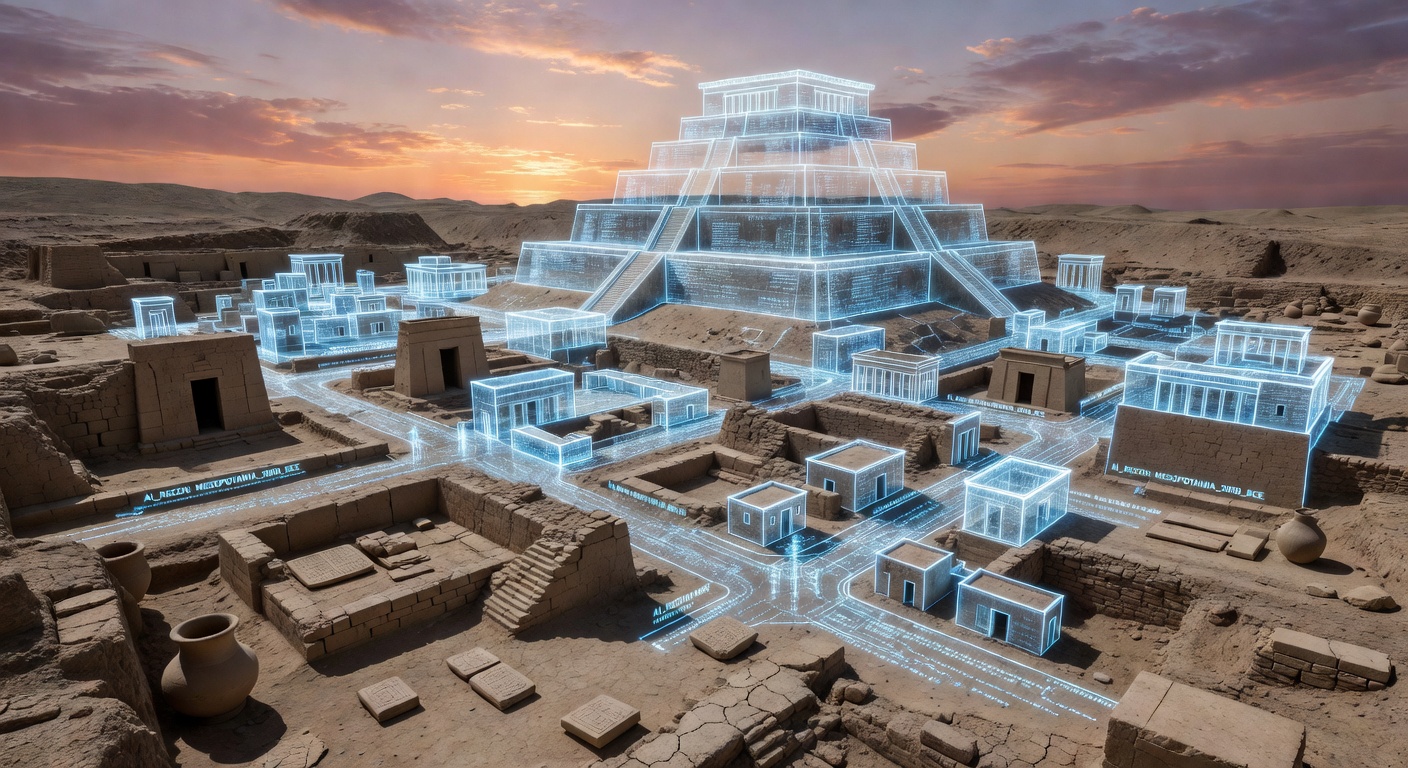
Mesopotamia from Orbit: Predictive Archaeology
If LiDAR is revolutionizing jungle archaeology, AI-driven satellite imagery is transforming our understanding of ancient Mesopotamia—the “cradle of civilization” between the Tigris and Euphrates rivers. Here, the challenges are different but equally daunting: thousands of tells (artificial mounds created by millennia of human occupation) dot the landscape, but limited resources mean only a fraction can be excavated.
Researchers at Harvard and the University of Pennsylvania have developed algorithms that can identify potential archaeological sites from satellite imagery with over 80% accuracy. By training neural networks on known sites and their characteristic “signatures”—subtle differences in vegetation, soil color, and topography that indicate buried structures—these systems can survey vast areas in hours rather than decades.
More remarkably, these AI systems can predict which sites are most likely to contain significant remains based on factors including proximity to ancient watercourses, strategic positioning, and settlement patterns. This “predictive archaeology” allows researchers to prioritize excavations, focusing limited resources on sites with the highest probability of yielding important discoveries.
“We’re essentially teaching computers to think like archaeologists—to recognize the subtle patterns that indicate human activity across thousands of years. The result is a tool that can survey an entire civilization’s footprint in a fraction of the time it would take traditional methods.”
— Dr. Jason Ur, Harvard University
In 2024, this approach led to the discovery of a previously unknown Sumerian city in southern Iraq, identified through AI analysis of commercial satellite imagery. The site, tentatively named “Larsa Nova” by researchers, shows evidence of occupation spanning over 3,000 years and may rival major known centers like Ur and Uruk in significance.
Section III: The Celestial Codebreakers
Beyond finding cities and reading texts, AI is revealing patterns in ancient architecture that have eluded researchers for centuries—particularly the astronomical alignments that governed the orientation and construction of ancient structures worldwide.
Pattern Recognition and Ancient Astronomy
From Stonehenge to the pyramids of Egypt, from the temples of Angkor Wat to the observatories of Chichen Itza, ancient peoples oriented their most sacred structures toward celestial events: solstices, equinoxes, lunar standstills, and the rising of specific stars. Identifying these alignments traditionally required painstaking measurement and astronomical calculation.
Today, AI algorithms can analyze the orientation of thousands of structures simultaneously, identifying patterns that suggest shared astronomical knowledge across vast distances and time periods. A 2024 study using machine learning analyzed over 4,000 megalithic structures across Europe and found that 92% showed significant solar or lunar alignments—far more than previously recognized through traditional analysis.
Key AI applications in archaeoastronomy include:
- Alignment detection: Algorithms calculating precise orientations of ancient structures and comparing them to celestial events across historical periods
- Pattern clustering: Machine learning identifying groups of structures with similar orientations, suggesting cultural connections or shared knowledge
- Chronological refinement: AI using astronomical precession (the slow change in Earth’s axial tilt) to refine dating of undated structures
- 3D reconstruction: Neural networks reconstructing damaged structures to determine original alignments
The Great Pyramid’s Hidden Chambers
Among the most spectacular AI-assisted discoveries in recent years was the identification of a hidden chamber in the Great Pyramid of Giza. In 2017, the ScanPyramids project used muon radiography—detecting subatomic particles that penetrate dense materials—to identify a previously unknown void above the Grand Gallery. The analysis that confirmed this discovery relied heavily on AI algorithms to distinguish meaningful patterns from background noise.
Subsequent research in 2024 has suggested this chamber may be part of a more complex internal structure than previously imagined, with AI analysis of various scanning data suggesting multiple interconnected spaces that could reshape our understanding of how the pyramid was constructed and what it contains.
Section IV: The Ethics of Digital Archaeology
For all its promise, the AI revolution in archaeology raises profound ethical questions that the field is only beginning to grapple with. As we develop increasingly powerful tools for revealing the past, we must ask: should we uncover all secrets? And if so, on whose terms?
Indigenous Knowledge and Digital Colonialism
Many of the sites now being surveyed by AI belong to landscapes that remain sacred to Indigenous communities. The question of who controls archaeological data—and who benefits from its interpretation—has taken on new urgency in the age of digital archaeology.
When AI algorithms survey Native American sites in the American Southwest, Aboriginal sacred landscapes in Australia, or Indigenous territories in the Amazon, they generate data that has commercial, political, and spiritual implications. Without meaningful consultation with descendant communities, this research risks perpetuating colonial patterns of extraction—taking knowledge without consent and using it in ways that may conflict with Indigenous values.
Leading AI archaeology projects are increasingly incorporating community-based participatory research models, ensuring that:
- Indigenous communities have veto power over publication of sensitive site locations
- Descendant communities are involved in interpreting findings
- Commercial applications of archaeological data benefit local communities
- Sacred sites are protected from disturbance even when technology makes them “visible”
The Digital Divide in Archaeology
There’s also a practical concern: AI archaeology requires resources—computational power, technical expertise, and institutional support—that are concentrated in wealthy institutions and nations. This risks creating a two-tier system where archaeological heritage from the Global North receives cutting-edge analysis while equally significant sites in the developing world languish in relative obscurity.
Organizations like the Digital Heritage Research Lab and the AI for Good Foundation are working to democratize access to these tools, developing open-source algorithms and training programs for archaeologists worldwide. But the gap remains significant, and addressing it will require sustained commitment from the international archaeological community.
Authenticity and Interpretation
Finally, there’s the question of what AI-generated interpretations mean for archaeological authenticity. When Ithaca suggests a restoration of a damaged inscription, or when an algorithm predicts the location of a lost city, how should we weigh these machine-generated hypotheses against traditional forms of evidence?
The consensus emerging among practitioners is that AI should augment, not replace, human expertise. The most successful applications of AI in archaeology involve collaboration—machines handling data processing and pattern recognition at scales impossible for humans, while human experts provide context, critical evaluation, and cultural interpretation.
“AI can show us patterns we might never see. But understanding what those patterns mean—why ancient peoples built what they built, believed what they believed, lived how they lived—that remains fundamentally human work. The machine opens the door; we still have to walk through it.”
— Dr. Sarah Parcak, Space Archaeologist, University of Alabama at Birmingham
Conclusion: The Future Written in Algorithms
As we stand at the threshold of this new era in archaeological discovery, the possibilities seem boundless. The combination of AI with emerging technologies—from quantum sensors that can detect buried structures at unprecedented depths to DNA analysis that can reconstruct ancient populations—promises a future where our understanding of human history grows exponentially.
Yet technology alone cannot answer the fundamental questions that draw us to archaeology: Who were these ancient peoples? What did they believe? How did they understand their world? AI can reveal the patterns of their lives—the cities they built, the texts they wrote, the stars they followed—but the meaning of those patterns remains ours to interpret.
In my own work studying folklore and supernatural beliefs across cultures, I’ve often found that the most profound insights come not from what ancient peoples left behind, but from how we choose to engage with their legacy. The AI revolution in archaeology gives us unprecedented access to that legacy. What we do with it—whether we approach it with respect, humility, and collaboration across cultures—will define not just our understanding of the past, but our character in the present.
The ancients left us mysteries that have endured for millennia. Today, we have tools our ancestors could never have imagined. The story of how we use them—of what we choose to uncover, preserve, and honor—will be the next chapter in the ongoing human project of understanding ourselves through the traces of those who came before.
Raelynn Pickett is an anthropologist and folklore specialist focusing on the intersection of archaeological evidence and supernatural belief systems. She has conducted fieldwork across four continents and is currently researching patterns of celestial veneration in Neolithic European cultures.
About the Author