The narrow places of the world have always collected their fee
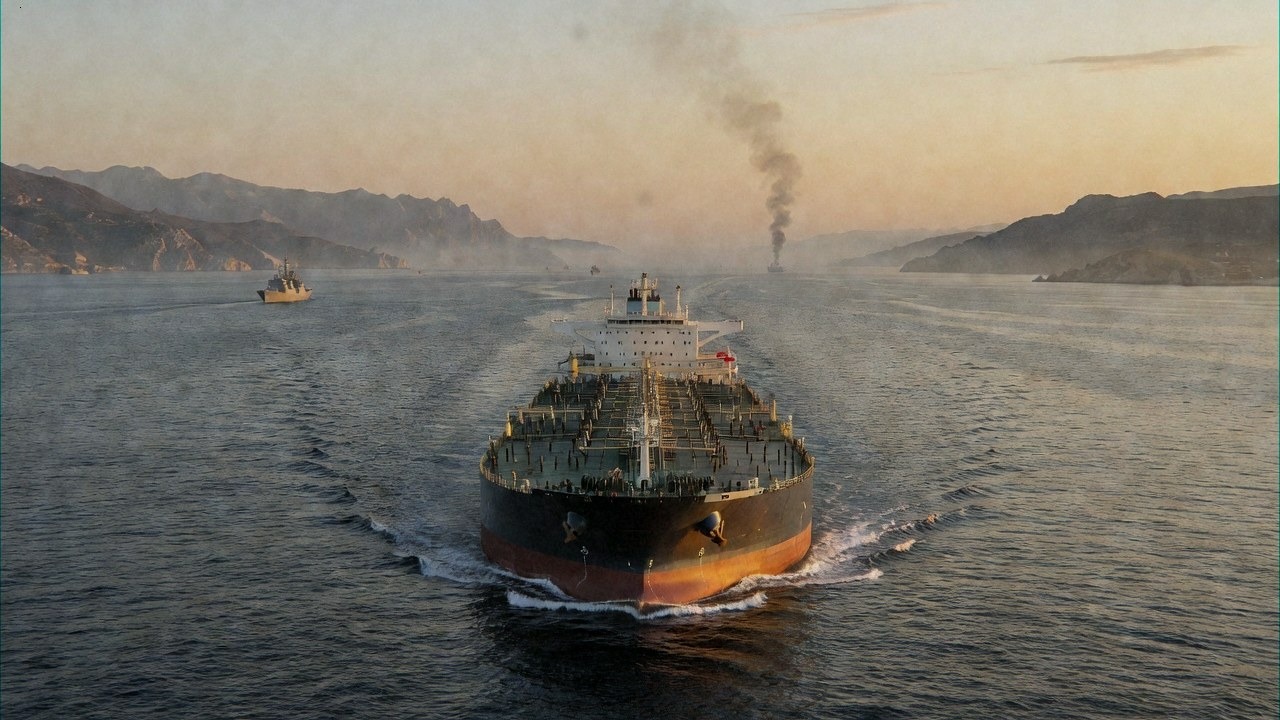
At some point on the night of 22 October, seven tankers in the Strait of Hormuz were hit. The Iranian Revolutionary Guard said it did it. Brent crude jumped about four percent to roughly 113 dollars a barrel, freight rates to Asia hit records, and a single voyage now costs more than 44 million dollars to insure and charter. Traders called it the worst night for shipping since March.
It is also, in the long view, an ordinary night. The Strait of Hormuz has been in the business of ruining someone's plans for about five thousand years, and it has never once been talked out of it.
The water there is 21 miles wide at its narrowest, split into two shipping lanes of two miles each. Something close to 20 million barrels of oil passes through every day, about a fifth of what the world burns, plus a third of the liquefied natural gas trade. There is no alternative that scales. There are pipelines, and we will get to them, but there has never been a bypass that mattered when the shooting started.
What makes Hormuz interesting isn't the oil. It's the pattern. Every few centuries, the world builds an economy that runs through a gap in the rock, and then discovers that whoever stands on the rock has opinions.
The king who whipped the sea
Start with the Hellespont, because it is the oldest place where a superpower learned this lesson in public.
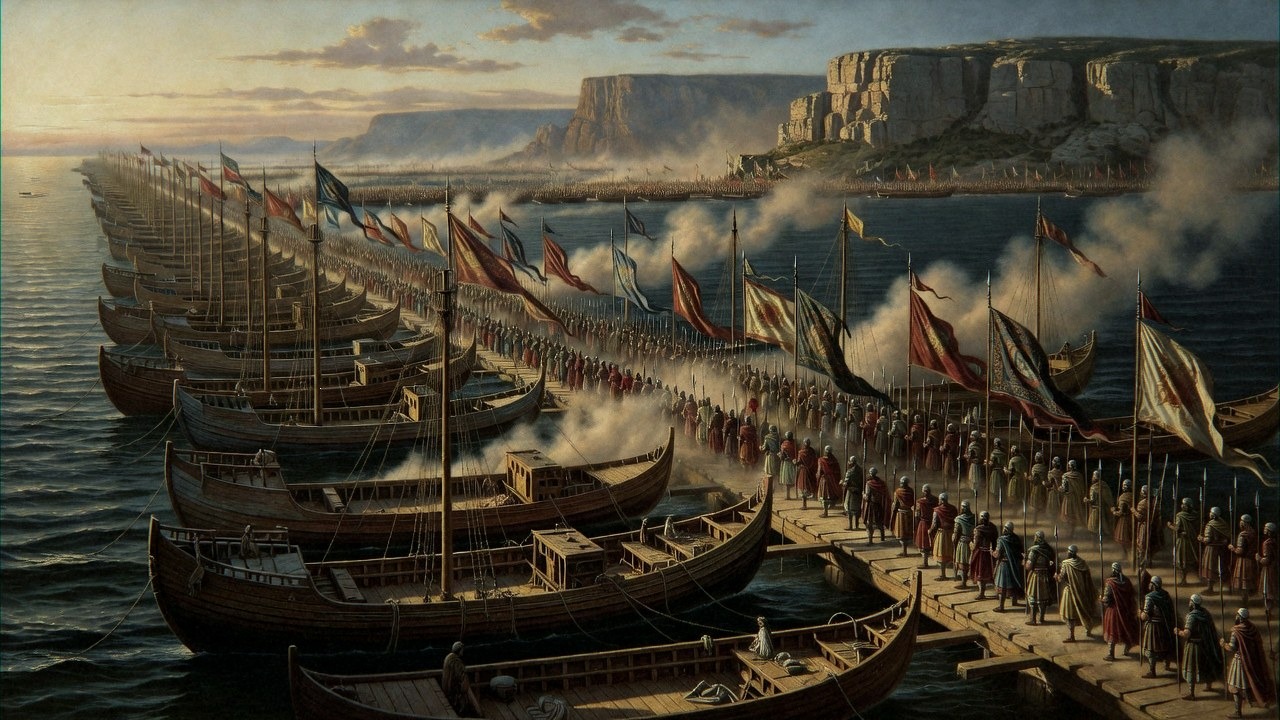
In 480 BC Xerxes I, king of kings, needed to move an army of perhaps 150,000 men and a fleet of 1,200 ships from Asia into Greece. The Hellespont, today's Dardanelles, is a 61 kilometre ribbon of water, and at its narrowest it is a little over a kilometre across. Xerxes ordered a pontoon bridge built from Abydos, 674 ships lashed together side by side, decked with timber and earth, with gaps left open so that small craft could still pass underneath.
Then a storm tore it apart.
Herodotus records what happened next. Xerxes had the engineers executed, and then he had the water itself punished. Three hundred lashes across the surface of the strait, while soldiers shouted at it, and a pair of shackles was lowered into the deep as a symbolic binding of the sea. It is one of the great comic scenes of antiquity, a man treating a body of water as a disobedient servant, and every century since has produced a ruler who repeated the gesture with better equipment.
The second bridge held. The army crossed for seven days and seven nights. And in the same season, three hundred Spartans and about seven hundred Thespians died holding a road fifteen metres wide at Thermopylae, which is the land version of the same argument. Narrow places decide wars, and they decide them cheaply. You do not need a bigger army. You need a smaller door.
Xerxes lost anyway, at Salamis, in another strait, where his numbers became a liability. The pattern was already complete by 479 BC. A chokepoint gives enormous leverage to whoever holds it, and then punishes whoever tries to use that leverage without understanding the water.
The Clashing Rocks
The Greeks had a word for what a strait does to a ship. They put it in a myth.
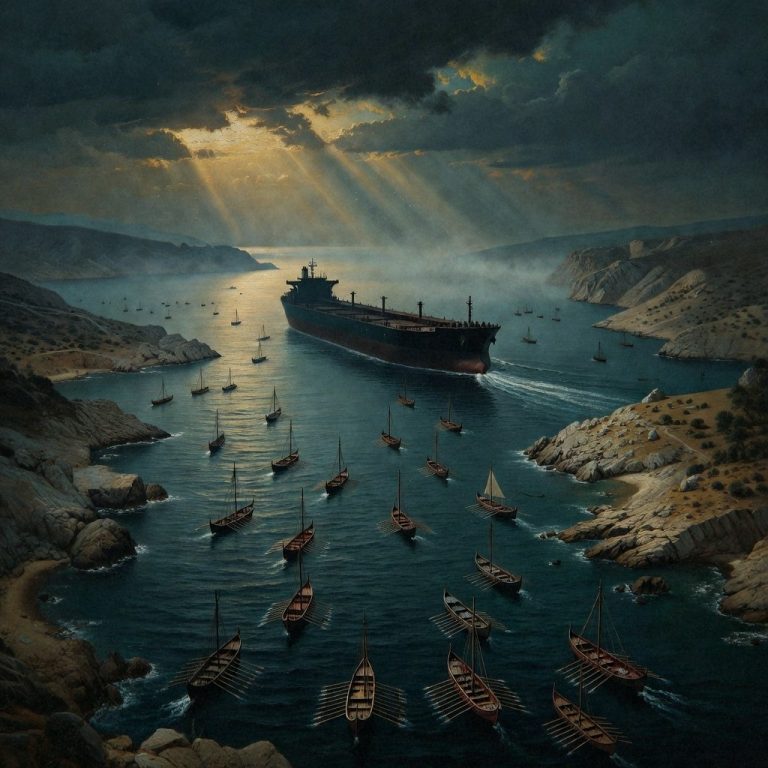
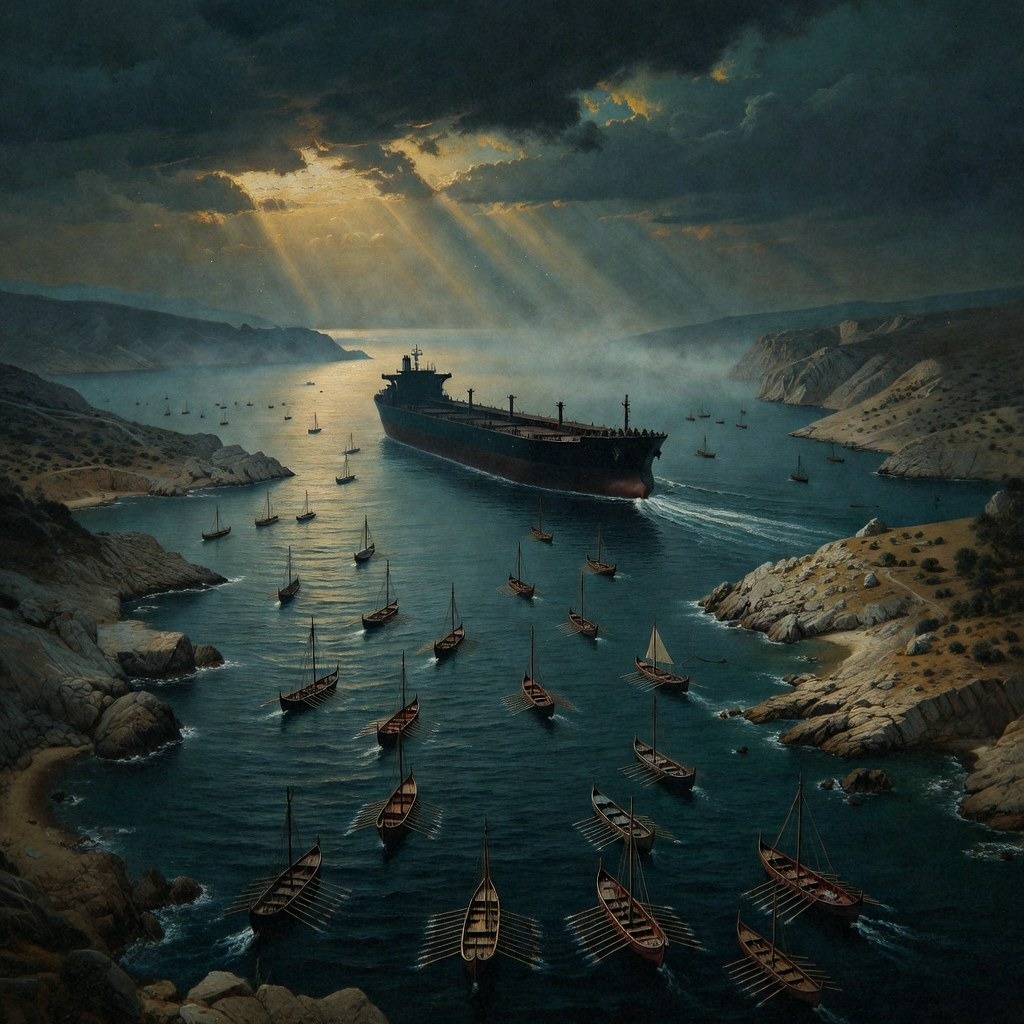
The Symplegades, the Clashing Rocks, guarded the entrance to the Black Sea. Two great stones that drifted together and crushed anything between them. Jason and the Argonauts got through by sending a dove ahead, timing the passage, and rowing hard while the rocks rebounded. Every generation of sailors has told some version of that story, because every generation has felt the same thing: the sea narrows, and the walls start moving.
The Bosporus is 700 metres wide at its tightest point and 31 kilometres long. It is not a myth, it is a revenue stream. By the fifth century BC, Athens depended on grain from the Black Sea, and Byzantium, sitting on the southern mouth, understood exactly what it was holding. In 410 BC Alcibiades installed a customs station at Chrysopolis on the Asian side and levied a ten percent tax on every ship passing into the Euxine. It was, in modern terms, a toll booth with a navy.
Athens could not live without that grain. Neither could the Roman Empire later, which is why the city of Constantinople was built on the spot, and why its survival for a thousand years depended on fleets arriving from Egypt through another set of narrows. When Mehmed II took the city in 1453, he did not just capture a capital. He took possession of the throat of the world's grain and fur trade, and every Russian prince for the next four centuries knew it.
The straits are still governed by a treaty written in 1936, in Montreux, by people who had watched a war start over access to them. Turkey signed it, and Turkey has been reinterpreting it ever since. Geography writes the rules. Diplomacy only writes the footnotes.
The Gate of Tears
The Arab name for Bab el-Mandeb is Bab el-Mandeb, the Gate of Tears, and the etymology is disputed, but nobody who has sailed it argues with the sentiment. Eighteen miles separate Yemen from Djibouti. Perim Island sits in the middle and splits the channel into a two mile eastern passage and a sixteen mile western one. It is the southern entrance to the Red Sea, and therefore the seaward end of the Suez Canal.
In the first century AD, an anonymous Greek merchant wrote the Periplus of the Erythraean Sea, a plain sailing guide to this coast. It lists Adulis, the port of the Aksumite kingdom, and describes the trade in ivory, tortoiseshell and frankincense moving north while Indian cloth and Roman coin moved south. The strait was already a bottleneck in a supply chain that stretched from Muziris to Ostia, and the whole system depended on a handful of ports that could be closed by one bad governor.
The Portuguese arrived in 1513 under Afonso de Albuquerque and tried to take it. They failed, then spent a century building forts on both shores anyway, because a strait you cannot hold is still a strait you can make expensive. When the Suez Canal opened in 1869, the Gate of Tears became the front door to Europe's Asian empire overnight. When Egypt closed the canal in 1967, it stayed shut for eight years, and fifteen ships sat trapped in the Great Bitter Lake for the entire period, rusting in place.
Between 2023 and 2025 the Houthis reminded everyone what the gate is for. Container traffic through the Red Sea collapsed, ships went around Africa, and the added distance cost the world economy more than most of the actual fighting. The response, in the end, was not a decisive battle. It was a long expensive detour, which is how chokepoints usually win. They do not have to be held. They only have to be doubted.
The island that taxed the world
Hormuz is the purest case in history, because it is almost nothing but a strait with a tax office attached.
When Albuquerque took the island in 1507, he was not interested in its soil. He was interested in the fact that every ship moving between India, Arabia and Europe had to pass within sight of it. The Portuguese built a fortress called Our Lady of the Conception, with a cistern that could hold water for a siege, and for over a century they taxed the spice trade at the point where it narrowed. They did not conquer Asia. They stood in the doorway and held out a hand.
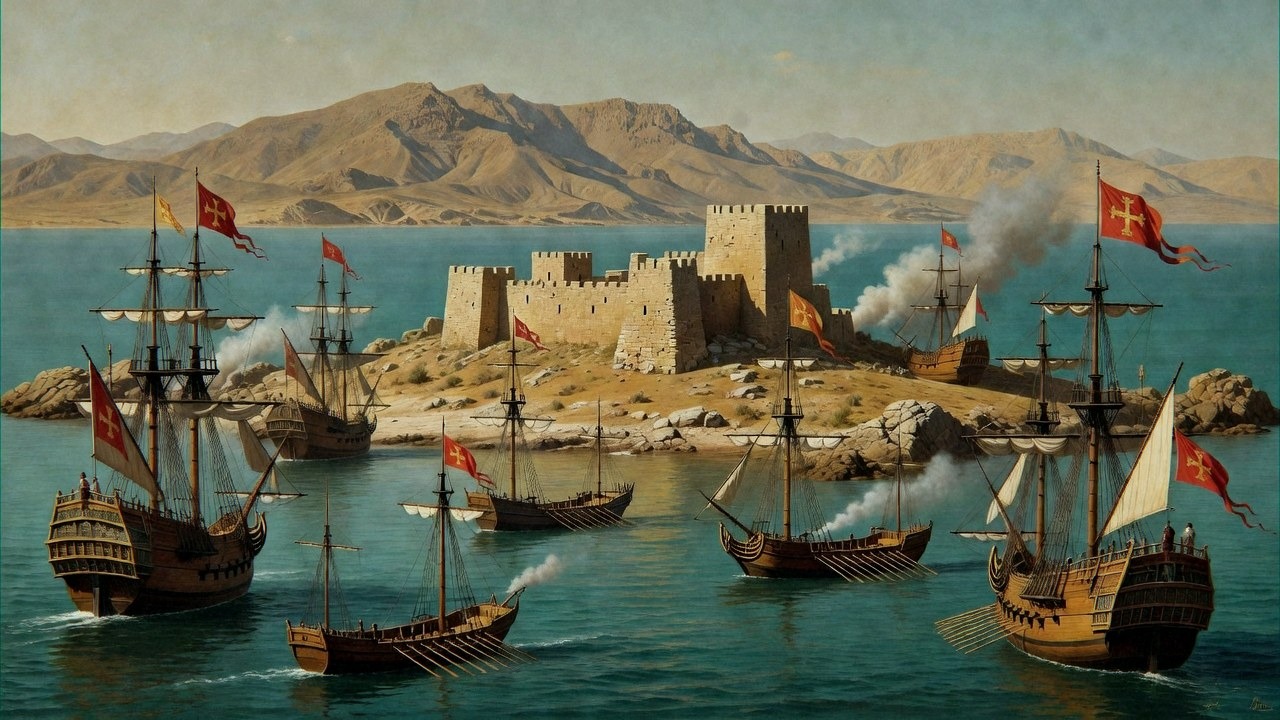
The arrangement collapsed in 1622 when an English fleet helped Shah Abbas of Persia take the island. The Portuguese moved their base to Muscat. The Omanis took over the collection. The British eventually took over the Omanis, mostly by treaty and gunboat, and stayed in the Gulf until 1971. Different flags, same rock, same logic.
It is worth being clear about what the British actually built there. Not an empire of territory, but an empire of passage, a chain of coaling stations and treaties from Aden to Singapore whose entire purpose was to keep the narrow places open and friendly. The Royal Navy's real product was predictability. A captain could sail from Suez to Bombay without asking permission from anyone, because someone had already bought the doorways.
The United States inherited that role in 1980, in a speech that named the doctrine after the region rather than the strait. In 1987, during the Tanker War, it reflagged eleven Kuwaiti tankers as American ships and escorted them through Hormuz, which is a remarkable thing when you think about it. The solution to a chokepoint crisis was to change the paperwork on the hulls. In April 1988, Operation Praying Mantis destroyed two Iranian oil platforms in a single day in retaliation for a mine strike. The strait has been a live military problem for forty years, and the news this week is not a rupture. It is a recurrence.
Malacca, and the sound of Danish cash
The Strait of Malacca is 2.8 kilometres wide at its narrowest, and roughly a quarter of all traded goods move through it. For a thousand years the empire that controlled it was Srivijaya, a maritime state based in Sumatra that never bothered with large armies. It controlled the water, taxed the ships, and grew rich on other people's cargo. Zheng He's treasure fleets passed through in the fifteenth century and found a client state. The Portuguese took it in 1511. The Dutch took it from them in 1641 and held it until the British swapped it away in 1824 for a trading post in Sumatra, a transaction that rearranged two empires for a century.
There is a northern European parallel that almost nobody mentions, and it is the cleanest illustration of the whole principle. From 1429 until 1857, Denmark collected the Sound Dues, a toll on every ship passing between the North Sea and the Baltic through the Oresund. It was not a large tax per ship. It did not need to be. It was a few percent of everything, forever, and it financed the Danish state for four centuries. The Baltic trade of the Hanseatic League, the Dutch grain runs, the Swedish copper exports, all of it paid Copenhagen for the privilege of passing a four kilometre gap. The dues were finally abolished in 1857, and the price of abolition was 67 million rix-dollars paid to Denmark by the shipping nations, which is what it costs to buy a toll booth out of a geography.
Why geography keeps beating technology
Every generation believes it has solved the strait problem. The Suez Canal solved the Cape route in 1869. The Panama Canal solved the Cape Horn route in 1914. Ships got bigger, navigation got satellite precise, insurance got actuarial, and the world got a genuinely global supply chain.
And Hormuz still has 21 miles of water.
The bypasses exist. Saudi Arabia's East-West pipeline can move about five million barrels a day to the Red Sea. The UAE's Habshan-Fujairah line adds another 1.5 million. On paper, the Gulf can route around the strait. In practice, the nameplate numbers assume everything works, nothing is attacked, and the receiving terminals are not also inside missile range. The realistic figure is a fraction of the 20 million barrels that normally pass. Iraq's northern export line has been unreliable for decades. There is no parallel universe in which a shutdown of Hormuz is a manageable inconvenience.
The Northern Sea Route gets trotted out every summer, and every summer it carries a rounding error of global trade, for four or five months, with ice class hulls and no rescue infrastructure. Rail between China and Europe is real and useful and carries a sliver of the value. Air freight is for things that fit in a pocket.
Technology compresses distance. It has never once moved a coastline. Every improvement in shipping efficiency makes the chokepoint more valuable, not less, because more cargo per day means more loss per day of closure. The strait gets richer as the world gets more connected.
The oldest machine
There is a temptation to treat this as a story about oil, or about Iran, or about the current American administration's electoral calendar. It is none of those things. Oil is just the current cargo. The machine is older than the cargo.
In the twelfth century BC, the palace economies of the eastern Mediterranean collapsed within about fifty years of each other. Mycenae, Hattusa, Ugarit, the trade networks that fed them. The mechanism was a system of long thin supply chains for tin and copper, moving through a small number of ports and passes, each of which depended on the others continuing to function. When a few of them failed, the whole structure came down, and the scribes who recorded the last shipments at Ugarit were still writing in a script nobody would read again for three thousand years.
Eric Cline called it 1177 BC, and the striking thing about his account is how modern the failure mode looks. Not a single decisive battle. A cascade, triggered by the interruption of routes that everyone had assumed were permanent.
That is what a chokepoint really is. Not a place where wars happen, but a place where a system discovers how thin it is.
So watch Hormuz this week, and watch what happens after the headlines move on. The tankers will reroute, the insurance market will reprice, the navies will escort, and the price of a barrel will settle somewhere a little higher than it was. Then the next crisis will find the same 21 miles of water waiting, with the same cliffs on either side, still collecting its fee in the only currency it has ever accepted. Attention, and then blood.
Xerxes whipped the sea and it did not notice. The Portuguese built a fortress and the island outlived them. The British drew treaties across the Gulf and left. Seven tankers burned last night, and the strait is exactly where it was.
It is not a route. It is a machine that eats empires and returns nothing but invoices.
About the Author